MuchSearchGuides & playbooks
AI Search vs Traditional Search: When to Use Which (2027 Guide)
AI answer engines and classic index search fail in different ways. A practical decision framework for choosing between Google, Perplexity, ChatGPT and vertical search — with a table you can actually use.
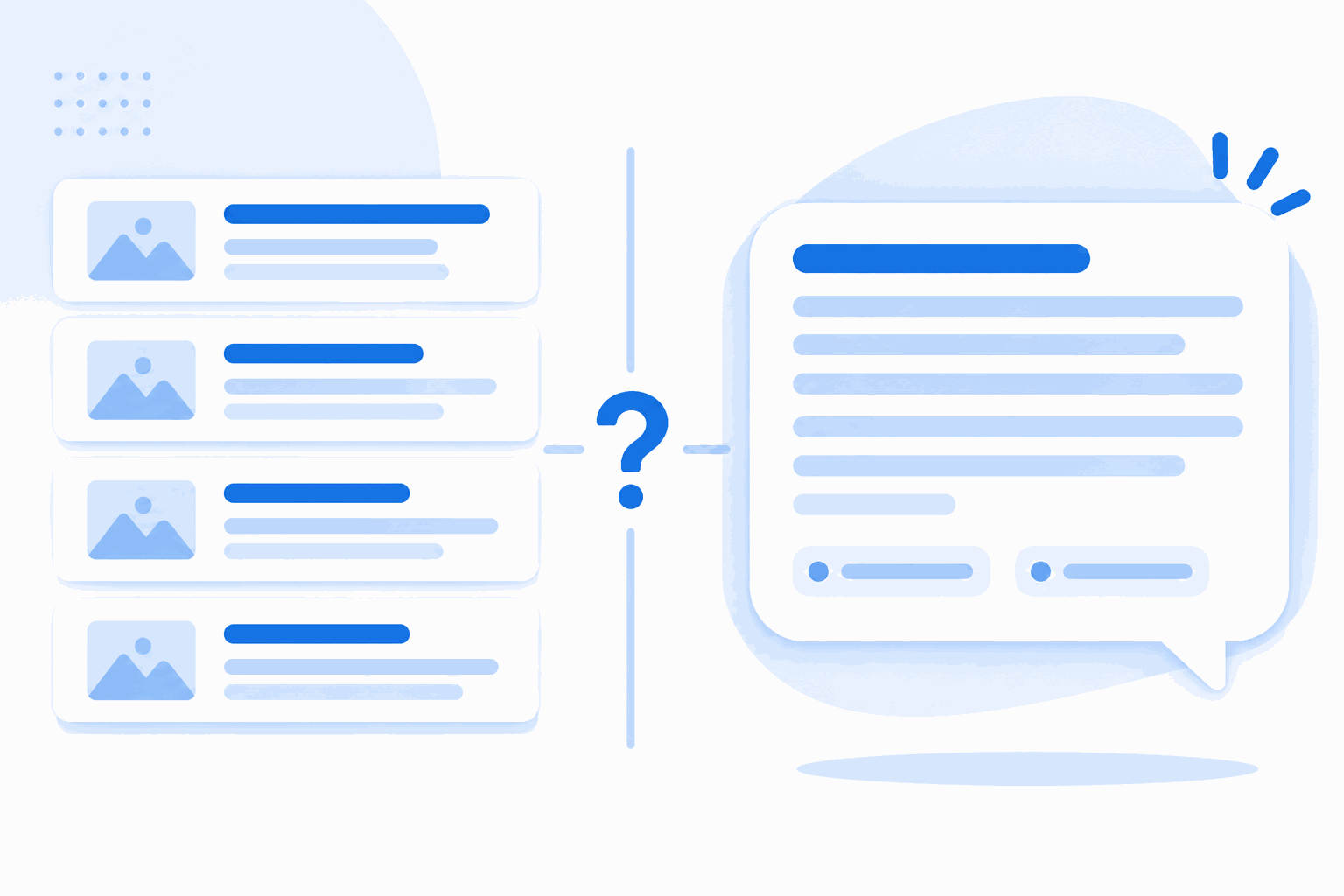
Two camps argue about this constantly. One says AI search is the end of the blue link. The other says language models are confident liars and Google still wins. Both are right about half the problem, which is why the argument never resolves.
The useful question is not “which is better” but “which failure mode can I afford today”. Index search fails by omission — the page exists and you cannot find it. AI search fails by invention — the answer is fluent, specific and wrong.
The mechanical difference
Traditional search is retrieval. A crawler indexes pages; your query is matched against that index; you get ranked links. The system’s job ends at “here are candidates”. Judgement stays with you.
AI search is retrieval plus generation. Something fetches context — a live web index, a cached corpus, or nothing at all — and a model writes an answer. The system’s job ends at “here is a conclusion”. Judgement has been partly outsourced, which is exactly why you need to check it.
Conversational models (ChatGPT, Claude, Copilot) sit one step further: they can reason across what you tell them and what they retrieve, hold a long context, and let you revise the question. That is a genuine capability, not a UX trick — but it also means the model can drift from the source without ever contradicting itself visibly.
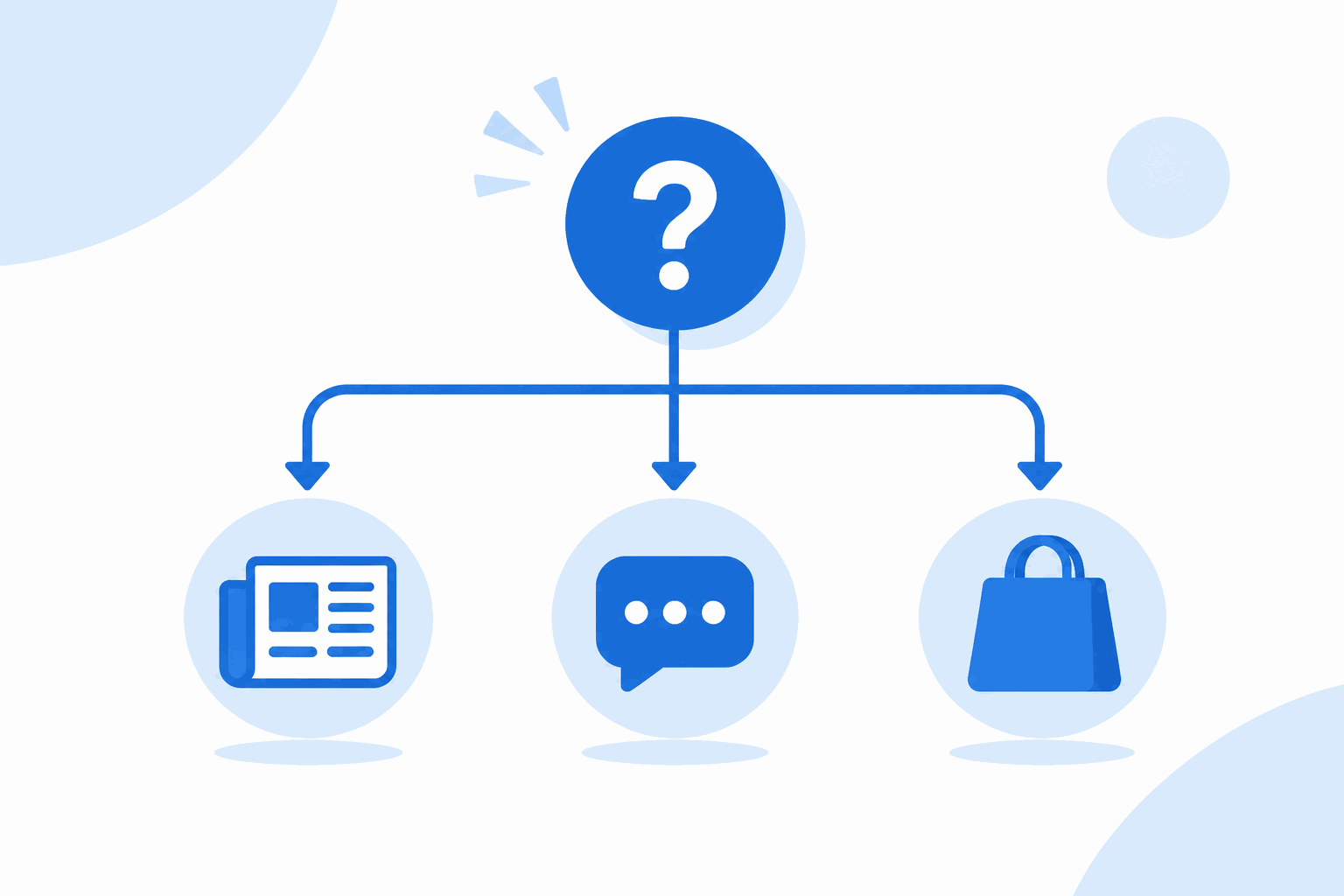
Decision table
| Task | Use | Because |
|---|---|---|
| Find the official download page for a tool | Google / Bing | Exact-page retrieval is what indexes do best |
| “Explain how TLS handshakes work” | ChatGPT / Claude | Conceptual explanation, no freshness requirement |
| “What changed in the latest release?” | Perplexity + release notes | Needs citations and a date; model memory is stale |
| Compare three vendors’ pricing | AI for the framework, vendor pages for numbers | Prices change; only the primary page is authoritative |
| Find a local dentist open Saturday | Google Maps | Local index, reviews, opening hours |
| Debug an obscure error message | Stack Overflow + GitHub issues | AI often paraphrases the accepted answer badly |
| Draft a report from sources you already trust | Claude / ChatGPT with pasted sources | Synthesis is the strength; give it the evidence yourself |
| Check whether a viral claim is true | Reuters, AP, BBC + Google News | Editorial accountability beats fluency |
Three scenes where the choice is obvious
Scene 1 — You are buying a used lens
An AI engine will happily produce a “fair price” for a 2019 35mm f/1.4. That number is a hallucination with a decimal point. What you need is eBay sold listings, filtered by condition, plus a forum thread about the specific serial range with focus shift. Index search and vertical sites win outright; AI is only useful afterwards to explain what “schneideritis” means.
Scene 2 — You are writing an internal explainer on EU AI Act obligations
Here AI earns its keep first: ask for a structured outline of obligations by role (provider, deployer, importer), then ask it to flag which statements need a citation. You then verify each flagged claim against the official text. Starting from Google would give you twenty law-firm blog posts of varying accuracy and no structure.
Scene 3 — Your production deploy fails with a stack trace
Paste the error into Stack Overflow first — someone has had it. Then GitHub issues for the exact version. AI is third, and only with the error text, the version and the relevant config pasted in; a general “why does my build fail” prompt returns plausible nonsense.
The hybrid workflow that actually saves time
- Frame the question in one sentence. Constraints included: who it is for, what decision it feeds, what you already know.
- Send it to an AI engine to get the shape of the answer and the vocabulary you did not know you needed. Note the terms it introduces.
- Send those terms to a traditional engine — the jargon it taught you is the best query you will get all day.
- Cross-check one primary source per claim. Not a blog about the source. The source.
- Keep a two-line log of what you accepted and what you rejected. Next time, you start from your own notes instead of a blank prompt.
The step people skip is 3, and it is the highest-leverage one. A model’s vocabulary is a query generator; use it as one.
Five smells that an AI answer is unsafe to use
- Specific numbers without a source. Prices, dates, statistics, market sizes. If it cannot cite, it is guessing.
- Perfectly balanced both-sides framing on a question with an empirical answer. Fluency is not accuracy.
- Citations that do not open, or open to a page that does not contain the claim.
- Confident naming of obscure APIs or config keys. Ask it to show the docs page; if it cannot, assume invention.
- Answers that never say “I don’t know”. A model that always answers is a model you cannot calibrate.
Teaching the split to a team
Individuals adapt; teams need a rule that survives a busy Tuesday. The one that works in practice is a three-line policy, not a training session.
Anything customer-facing gets a source. If the output will be sent to a client, published or filed, every factual claim needs a link a colleague can open. AI can write the draft; the link has to exist.
Anything with a number gets a primary check. Prices, dates, market sizes, legal deadlines. One person opens the primary document before the number goes anywhere.
Anything internal can stay fast. Internal notes, brainstorm material, first drafts — no citation needed, no gatekeeping. The rule should protect the output, not slow down thinking.
This split works because it is enforceable. “Be careful with AI” is not a policy; “no numbers without a primary source” is one you can audit in a document review.
The 90-second verification drill
When you cannot afford to be wrong, run this before you act on an AI answer. It takes about ninety seconds and catches most failures.
- Find the load-bearing claim. Every answer has one sentence that, if false, collapses the rest. Highlight it mentally.
- Open the citation. Not the snippet in the answer — the page. Search the page for three words from the claim. If they are not there, the citation is decorative.
- Search the claim as a quoted phrase. If the only pages containing that exact phrasing are AI-generated content farms, the claim was invented and then laundered through the web.
- Check the number against a primary source. Statistics need a named publisher, a date and a sample size. AI answers routinely cite plausible-looking figures with none of the three.
- Ask the model one adversarial question. “What would make this wrong?” A good answer names the assumptions; a bad one restates the original claim louder.
The drill is deliberately mechanical. Judgement fails under time pressure, and a fixed sequence survives pressure better than a principle.
Tasks where AI search genuinely wins
It is worth being specific, because the debate usually stays abstract:
- Turning a messy question into a structured one. “We might need a CRM” becomes a comparison framework in one prompt.
- Explaining unfamiliar vocabulary. The terms you learn then become better Google queries — the highest-leverage use in the whole workflow.
- Summarising documents you already trust. Paste the PDF; ask for the obligations, the deadlines and the exceptions. You can verify every line against text you supplied.
- Drafting the boring middle. Meeting notes into an agenda, a changelog into release notes, a transcript into a summary. No factual risk if the input is the source.
- Translation and tone. Rewriting the same message for a customer, a colleague and a regulator.
Notice the pattern: AI wins when the evidence is either already in front of you or not required at all.
A rule you can keep
Use AI to decide what to look for. Use search to find out whether it is true.
That single line resolves most of the debate. It also explains why the two categories belong on the same page rather than in separate bookmarks folders — which is the entire premise of a multi-search aggregator. If you want the mechanics of running both at once, see how to search Google, ChatGPT and Perplexity at once.
Frequently asked questions
Will AI search replace Google?
Not on current evidence. AI engines still depend on web indexes and news feeds for freshness, and they cannot show you a specific page, product listing or local result reliably. The realistic 2027 pattern is AI for synthesis, index search for evidence.
Why does ChatGPT give different answers to the same question?
Sampling randomness, model version, conversation context and retrieval results all change between runs. Google’s top ten also shifts, but more slowly. Treat any single AI answer as a draft, not a fact.
How do I verify an AI answer quickly?
Open the cited source and read the relevant paragraph, not the headline. If there is no citation, run the core claim as a quoted phrase in Google — if only AI-generated pages contain that exact phrasing, be suspicious.